I was lying on the floor at the back of the little church in St. Andrews when Irish poet and theologian Pádraig Ó Tuama began his commencement address to the graduates of St. Stephen’s University. I’d been anticipating this day for three years as I completed my studies and thesis for a Master’s in Theology and Culture. This day meant a lot because these three years had been transformative. I’d come to Canada with my husband Dave to walk, as they say. To receive my degree in person surrounded by faculty, mentors and friends. And here I was, lying on the floor. I think I’ve mentioned that.
We’d come from lunch to rehearsal for the ceremony. As we took our assigned places in line and walked into the sanctuary, I knew something was very wrong. I found the only bathroom located at the back of the sanctuary, at the end of a short, open hallway separated from the public space by a single wall. And I found it just in time. The waves of nausea did not relent. You’ll thank me for sparing you the details. At some point someone knocked on the locked door to check on me. I’d been in there a while and the sounds of my sickness carried in this little building. My illness was now public.
I knew I had been in the bathroom for about 20 minutes when I heard the ceremony begin. I would learn later that texts were now flying from the back of the church to the faculty seated at the front. The content was something like this. Susan is sick. Very sick. It will be a miracle if she can participate today. Do we need to get her to the hospital? What will we do about her award? Who might receive it for her? Award. I had no idea at that point I was about to get not only a diploma, but the Graduate Studies Award for Research Excellence.
As my system calmed a bit, I was finally able to shuffle out of the bathroom and sit on the floor in the little hallway. Drenched with sweat and unable to stand, I looked about for help. And at that moment, my dear friend (a daughter to me) Terese Lavallee came toward the bathroom. Assessing the situation quickly she went to get my husband. Together, they became a caregiving SWAT team. I laid on the floor as they applied cold compresses to pulse points and fanned me.
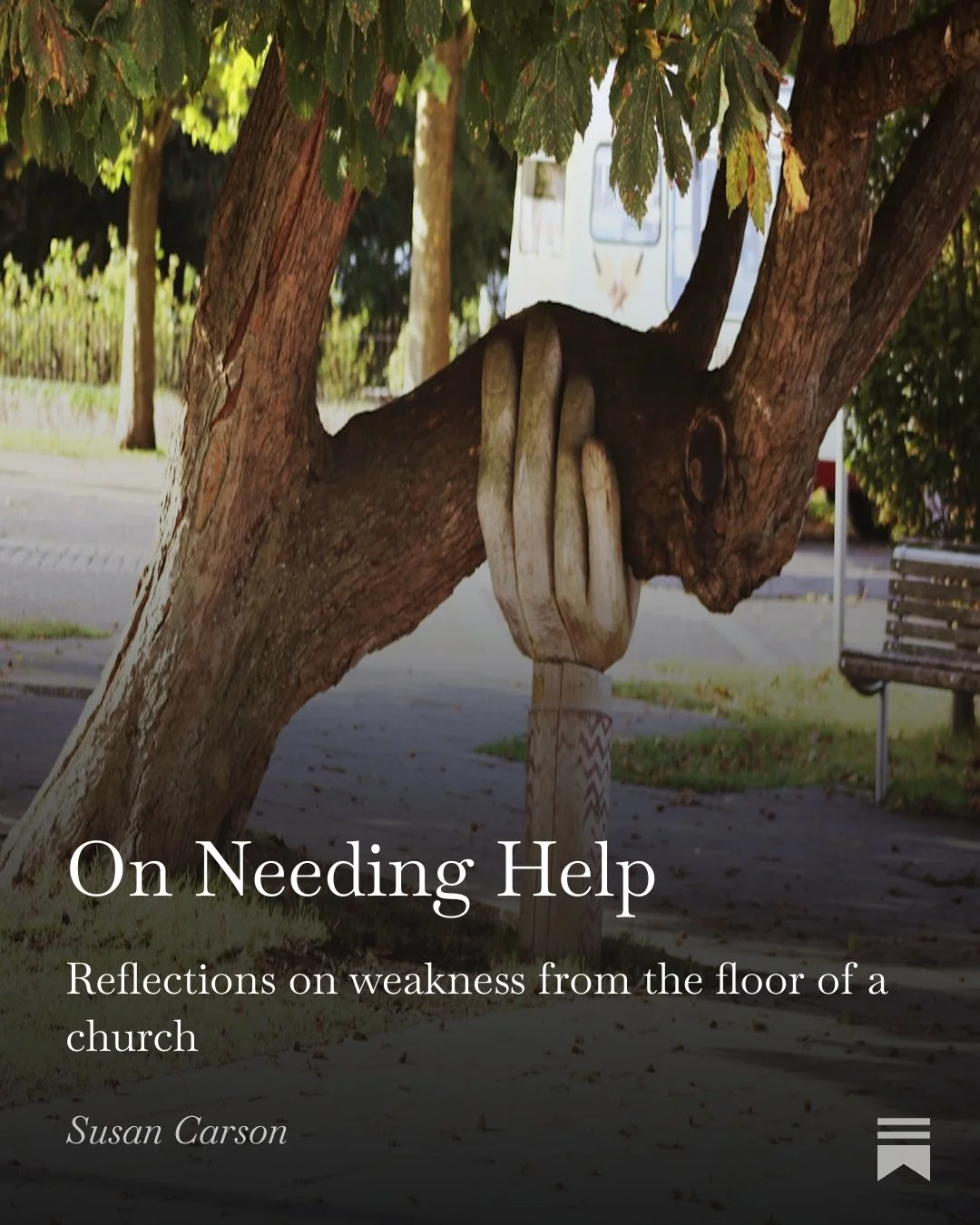
At this point, I became aware of Pádraig’s words. The title of his address was “Needing Help.” He was encouraging us to be not just givers of help in the world, but receivers. His words floated back to me,
“The awful truth is that you are not sufficient. None of us are. We are interdependent.”
How ironic. Here I was completely dependent on my helpers, and accutely aware that my need was public. As an Enneagram 4 with a strong inclination toward self-preservation, I do not enjoy this kind of public vulnerability. As Pádraig talked about shame and the reasons we find it hard to ask for and receive help, it occurred to me that, in some weird way, I was living what he was speaking. At one of the most joyful and significant moments of my life, I found myself so weak and needy. And somehow, both the joy and the weakness held space together. The compresses, the fanning, those helping and praying, it all felt like embodied love.
More words floated back. I didn’t get all the words, but I heard Pádraig’s meaning. “An Irish language word for help is cúnna. And the Cúán of the Dé Danann, we might say, with the help of a god. And the word cúnna means something like co-beget, and even more, conceive or conception….Help is always this co-making together. Truly. A co-making, a conceiving, a conception, the giving and the receiving of it. It is an intimate thing to offer and to receive help.”
Intimate, indeed.
Slowly now they helped me move from the floor to a chair. Terese has run out for Gatorade and Pepto which was being administered. Slowly they moved the chair and me from behind the wall so I could see the ceremony and the faculty at the front could see me. I read the concern on their faces. I felt the compassion.
On the floor, I’d been certain my day was over. But somehow when my name was called, I made the walk to the front of the church. Dean and dear friend Bradley Jersak moved to the edge of the stage to extend a hand and help me up the stairs. I received my diploma and hood, and made my way slowly back to my seat. I exhaled relief. I’d done the thing I’d come to do. I felt so uncomfortably conspicuous. My body felt depleted. I felt the love in the room, as one being held and helped. And it all collided in joy.
The ceremony continued. Beautiful music, then awards. Bradley was at the mic, and I was stunned to hear my name. Aware that all eyes were on me again, I stood in my weakness and tried to absorb Bradley’s words. Board member and dear friend Ernie Tai brought the award to me so I wouldn’t have to walk to the front again. I felt so deeply honored to receive this recognition for my thesis. And I felt profoundly vulnerable. And somehow it feels like these highest and lowest points formed something greater.
My thesis centers on the healing of our embodied traumas through embodied, face to face encounters with co-suffering love. Ancient mystics like Julian of Norwich and modern neuroscientists show us this way of being human together that heals us. It is a kenotic, self-emptying way (and I’d had a day of embodied emptying for sure). In a way I don’t fully understand, I was experiencing my thesis. The love in the room helped me heal in body, soul and spirit in ways I may never fully understand.
Pádraig completed his message with these words:
“….help is looking for something that is unexpected in a crisis of an expected disaster or shame. And that is what I want to encourage you with. With all of your studies, with all of the dedication, with all of your joy, and with all of the intelligence that you’ve got from your own life, from your readings, from your own thoughts, employ that for the purposes of mutual support, of the co-conceiving of something new, something small, something filled with life, something unexpected.”
The day held disappointments for me for sure. I missed the chance to experience this convocation with my classmates. I missed the photos outside after the ceremony. I missed the celebratory dinner and cocktails. But my weakness, the public shame and disappointments, did not negate the joy. In fact, strangely, it magnified it. This was, indeed, new and unexpected. Through the helping and praying and loving, something was co-created in me, something messy and holy and healing. Our weakness is the unexpected (and mostly unwanted) gift that requires us to depend on God and others. And in our interdependence we experience embodied compassion that heals.
My thanks to everyone who helped and prayed and loved that day. I’m deeply grateful.
Read Pádraig’s entire message here
This article was originally posted to my Substack 6/1/2026.